Experiments in Psychology have a long history of conflict and ethical issues since the beginning of the 1900s. Most of the prominent psychology experiments are not only famous for their impact on the human mind but also for their questionable methods of execution as well. There is no denying that some of them have caused great advancements in psychology; however, their lack of mindfulness regarding the condition of the test subjects, particularly human subjects, has led to the regulation of ethical standards. One of those now considered unethical experiments is called the Little Albert Experiment, in which an infant is used to determine if a phobia of an everyday item or an animal can be conditioned in humans. In this article, the Little Albert Experiment is discussed from various perspectives according to the field of psychology.
The Little Albert Experiment was conducted by psychologist John B. Watson and his assistant Rosalie Rayner in 1920. John B. Watson was a prominent figure in the field of psychology as he was the founder of behaviorism which has profoundly influenced the field for nearly 50 years. He was interested in human behavior and how the environment affected the behavior of one’s. According to Watson, psychology should focus primarily on observable behaviors rather than consciousness since it does not provide verifiable data and is therefore not scientific (1913, p. 158). This viewpoint led to the famous experiment being planned and carried out as the main goal of the experiment was to show empirical evidence of classical conditioning in humans. Classical conditioning is a type of learning that happens when one stimulus or event is paired with another stimulus or event, therefore creating an association of occurrence with one another stimulus (Gerrig, 2002, p. 146).
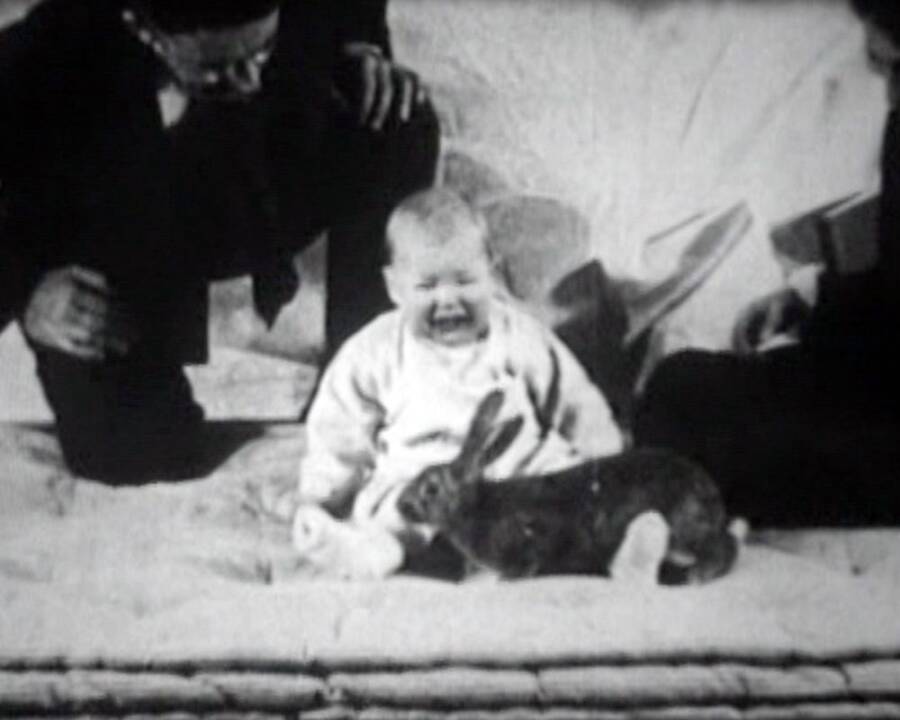
John B. Watson and Rosalie Rayner used an 11-month-old child called Albert B., which is a fake name used to conceal the real identity of the child. They aimed to test if fear could be conditioned in humans using Ivan Pavlov’s classical conditioning method of learning. According to the published issue of the Journal of Experimental Psychology, which contains John Watson’s report on the experiment, to determine if Albert initially had any fear response to the animals and objects that were going to be used, he was exposed to them. The animals and objects included a white rat, a rabbit, a dog, a monkey, masks with and without fur, cotton wool, etc. Once they made sure that he was emotionally stable and did not show any fear towards the objects, they proceeded with the experiment by separately showing Albert the animals and objects. The important part is, when Albert was exposed to the white rat, they made a loud noise by banging a hammer on a steel bar which caused Albert to become distressed and made him afraid. To condition him, the pairing of the white rat and the loud noise continued throughout the experiment, and when they exposed him to the white rat alone without the noise, he immediately showed fear in response to the sight of it. Although the sound pairing was only done with the white rat, it was observed that Albert also reacted in fear to the rabbit, santa-claus masks, and furry objects. This suggests that not only Albert was conditioned to fear the white rat, but he generalized it to other similar objects as well. Behavioral reactions of Albert illustrate that he developed an emotional response or rather, he developed a phobia of the sight of the white rat and any other relatively similar objects that were shown.
The Little Albert Experiment presents evidence of classical conditioning or fear conditioning in humans. Although it is an intriguing research, it has obvious issues regarding its methods of execution and ethical standards. Firstly, an experiment with this scale of seriousness must have objective ways to evaluate the outcomes; however, Watson and Rayner’s interpretations of Albert’s reaction were mostly biased since their evaluations were based on their own experiences. Also, the outcomes cannot be generalized to other people since the experiment was done with only one test subject. Secondly, the experiment is considered unethical by today’s ethical codes outlined by the American Psychological Association because the subject was an infant and was harmed throughout the experiments since he was being conditioned to fear animals and objects he was not afraid of before. Additionally, there was not any consent given to the experiment, in Albert’s case since he was an infant, Watson should have had the consent of an authorized person for him such as his mom. Another ethical issue of the experiment relates to the health condition of Albert. It is claimed that they might have used a neurologically impaired child as a subject because, in the films recorded by Watson and Rayner, Albert’s reaction times seem delayed and he seems generally unresponsive (Fridlund et al., 2012, para. 21). However, most of the recordings which were in short clips and later on joined together, and they only show Albert’s reactions to the animals and objects and nothing else. There is not enough footage to decide (Digidon et al., 2014, p. 317). Besides, it cannot be determined yet whether he was neurologically impaired or not because the identity of Albert is unknown.
The identity of Albert is still discussed and not yet certain, though according to Watson and Rayner’s report in the Journal of Experimental Psychology, his mother was working in Harriet Lane Home for Invalid Children as a wet nurse. With this information, Beck et al. state that an infant named Douglas Merritte, whose mother was also a wetnurse in the Harriet Lane Home, might be Albert himself since their date of birth, gender, race, and physical characteristics are similar (2009). Douglas Merritte died in 1925 so there is no further evidence to prove he was Albert. It is also claimed that there is another infant named Albert Barger whose characteristics match the recordings better than Douglas Merritte. Albert Barger’s mother was also a wetnurse in the same place, his features, date of birth, gender, race, and name of him were similar as well (Digidon et al., 2014, pp. 600-604).
The Little Albert Experiment has passed down to history as one of the most famous and unethical experiments in the field of psychology due to its mistreatment and exploitation of an infant. Experiments that are conducted carelessly might cause serious consequences for test subjects’ well-being, in Albert’s case, developing a phobia is one of those consequences. Although there are some issues with the Little Albert Experiment, as pointed out in this paper, it can be said that John B. Watson and Rosalie Rayner were able to show empirical evidence of classical conditioning, or rather fear conditioning, in humans. However, to ensure the test subjects’ state of health and the experiment’s credibility, ethical standards should be followed and experiments should be prepared for every detail.